Latest Updates
Tampilkan postingan dengan label Parent-talk. Tampilkan semua postingan

Every kid deserves a pair of jeans

By Megan Jones

In the summer of 2013, Mindy Scheier was faced with a problem. Her son Oliver, then nine, wanted to wear jeans to school.

Oliver, who has a rare form of muscular dystrophy, has trouble using buttons and zippers. He also wears leg braces, which don’t fit easily under restrictive fabrics like denim.

Mindy, who lives in Livingston, N.J., had a choice: she either had to tell her son he couldn’t wear the clothing he wanted, or send him to school without leg braces and risk that he might not be able to use the bathroom by himself.

“It was terrible,” she says. “I felt like I just didn’t know what the right thing to do was. Oliver views himself as a typical [child]. So he was completely confused as to why it was even a question whether he could wear jeans or not.”

In the end, Mindy let her son wear what he wanted. But the worry she felt as she sent him to school got her thinking about how limiting mainstream clothing was for children with disabilities. A fashion designer by trade, Mindy had adapted some of Oliver’s clothing in the past so that he could wear it comfortably. But the mom of three wondered how parents who didn’t have the sewing skills to modify off-the-shelf clothing managed to dress their kids with disabilities.

Then Mindy had a brainwave. Instead of thinking it was her responsibility as a parent to modify clothes that already existed, why didn’t she insist that companies create children’s wear that was adaptable in the first place?

With that idea in mind, Mindy, who in the past has worked for big names like Saks Fifth Avenue and Macy’s, decided to combine the two things she knew intimately about: clothing and disability.

Within a few months, she launched Runway of Dreams, a not-for-profit that aims to convince larger mainstream labels to produce adapted versions of current, fashionable clothes for children with disabilities. The company’s philosophy is simple: Kids deserve to wear whatever they want to wear. And it’s time for the fashion industry to step up and help them do it.

“We have plus-sized department and petite departments and maternity departments,” Mindy says. “And we have nothing for the differently abled community? It is so mind-boggling that this has not been done yet.”

Runway of Dreams isn’t the first company aimed at designing clothes specifically for kids with special needs. Other adapted clothing options exist, but they’re limited, often expensive and seldom trendy. Mindy hopes her project will ultimately give more people easy access to affordable clothes kids will actually want to wear.

Since she came up with the idea a year-and-a-half ago, Mindy has reached out to others to get a better sense of the range of clothing needs kids with disabilities have. She started with a large Facebook survey, which received answers from parents and children all over the world.

The survey revealed that people with disabilities struggled with three main things when it came to dressing. The first was fasteners: buttons, snaps and zippers seemed to be a problem for nearly everyone across the board. The second was the way clothing needed to be put on—kids with cerebral palsy or muscular dystrophy, for example, have low muscle tone, and can’t easily lift a sweater above their heads. The final issue was the ability to adjust the garment to fit—especially important for those with differently shaped bodies, and those with equipment like leg or back braces.

Using this information, Mindy designed a few prototypes and tested them with a group of high-school students and their parents at a school (see photo above). She partnered with Maura Horton, a Raleigh, N.C.-area woman whose company MagnaReady produces washable magnets that can be used in clothing.

They modified pieces with magnets—like a dress-shirt that opens along the back, allowing the wearer to slip their arms inside, and fastens easily.|

“It was one thing to talk to people but another to have them judge, feel, see the modifications that were made,” Mindy says.

Participants’ reactions confirmed for Mindy that Runway of Dreams was an important project. One boy with muscular dystrophy travelled an hour-and-a-half just to participate in the group. He told Mindy that he’d recently been accepted to Harvard, and that what he wanted most for his first day of university was to wear jeans like a typical freshman.

“Being able to wear what you want brings you personal confidence,” Mindy says.

“Differently abled kids are constantly being told, ‘You can’t play that,’ or ‘You can’t wear that.’ I think it will resonate that someone is saying, ‘You know what? You can actually. We’re going to make it happen.’”

So far, Runway of Dreams is in talks with one large clothing company, which Mindy hopes will lead to an official partnership. She’s also reaching out to other designers and manufacturers. Since adapted clothing caters to such an underserved market, she believes it’s in companies’ best interests to get involved.

“Forget about the feel good aspect of it,” she says. “There is a huge population of people out there that are ready and waiting for something like this to happen. They’ll spend their money on it.”

One day creating accessible clothing will be mandated, she predicts, and all companies will have to make a percentage of their clothing adaptable.

Until then, she’s pushing them to get involved. “As a mother, whether your kid has a disability or not, you know how hard it is not to have your child feel good about themselves,” she says. “I’m asking everybody to spread the word because we can make this happen together.”

At the very least, Mindy’s project has left her son (below) hopeful.

“Oliver and I were just interviewed on CNN,” Mindy says. “He ended the interview by saying, ‘I told my mum how lucky she is that I was born with muscular dystrophy. Because we wouldn’t be where we are right now if I didn’t have it!’”

To check out a great video on Mindy's work, or become more involved in the movement, visit
Runway of Dreams.  


Son's death sparks a search for justice

By Louise Kinross

In 2013 Connor Sparrowhawk (with sister Rosie) drowned in a bath alone in a National Health Services assessment and treatment unit in Oxfordshire, England. The 18-year-old had autism, epilepsy and intellectual disability (referred to as learning disability in the UK). The NHS trust that ran the unit initially attributed his death to natural causes—but his parents called for an independent investigation that found his death preventable. Twenty months later, Connor’s mother Sara Ryan, a senior researcher and autism specialist at Oxford University, is still seeking justice for her son.

BLOOM: Tell me about Connor.

Sara Ryan: He was very quirky and quite eccentric. He had an enormously brilliant sense of humour. He loved transport—buses and coaches. He had a bit of an encyclopedic knowledge of history. He was very good with facts and figures and loved the legal system and the police. But he couldn’t leave the house on his own because he had no road sense and he couldn’t count to ten.

BLOOM: When did he go to the unit called Slade House?

Sara Ryan: He went to secondary school from 11 till he turned 18 and he was a delight really. Then when he turned 18, almost overnight, he got really anxious and very unlike himself. He was difficult to engage with, had lots of dark thoughts, and was in and out of school because he was aggressive. He began bashing his head against the wall and I was worried he was going to hurt himself or someone else. The night we admitted him he wanted to go home and they had to restrain him on the floor with four people face down and section him. In all his life with us, we’d never laid a finger on him.

BLOOM: You had concerns after he went in, specifically about him having seizures there?

Sara Ryan: He was part of a happy family and the minute he went into the unit, because he was 18, they treated him as an adult. We had to phone up to get permission from him to visit, which was very odd. They didn’t engage us at all and changed his medication. I visited and could tell he’d had a seizure because he’d bit his tongue and was very disoriented. They disputed that.

BLOOM: What happened the day of his death?

Sara Ryan: I got a call that he was unconscious and on the way to the hospital in an ambulance. When I got there the consultant said straight away that he was ventilated but there was nothing they could do. They switched off the machine while I was there. Two weeks later the NHS trust published in its board minutes that a ‘service user’ had died of natural causes.

BLOOM: At the time of his death, Connor had been in the unit for 107 days but hadn’t been assessed or treated. What were they doing?

Sara Ryan: He was there for 107 days and the psychiatrist saw him three times. The psychologist filled in some questionnaires, but they didn’t come to anything. They said they were going to do social stories with him, but they never did that. He was a school boy and they should have been taking him to school. But they gave him choices, so he’d say no and stay in his room and watch DVDs.

BLOOM: How did you get an independent investigation into his death?

Sara Ryan: Before he went into the unit I’d been blogging about our family's life with Connor. It was about all the amusing things he did. Lots of people subscribed to it and became very fond of him. When I posted one line on the day he died it went viral. And when we found out the trust was saying he died of natural causes—and was going to do an internal investigation that clearly wasn’t going to find out anything—we made a lot of noise online and eventually they capitulated.

BLOOM: What did the independent investigation find?

Sara Ryan: That it was a preventable death. The staff had the knowledge. They knew he was epileptic and I’d told them he was having seizures in there and was sensitive to medication change. They hadn’t properly assessed his epilepsy and he was left unsupervised in the bath. Twenty months later we’re still waiting for an inquest and the police are still investigating.

BLOOM: I understand the unit was later closed?

Sara Ryan: Nothing happened after Connor died and we contacted the Care Quality Commission. They were about to do an inspection there. They were so shocked by what they saw that they failed the unit on all 10 quality and safety standards and the trust decided to shut the place down. There was no battery in the defibrillator. It was dirty and there was no therapeutic environment.

BLOOM: What accountability do you want from the NHS trust?

Sara Ryan: We want the staff to be disciplined, as appropriate, and a corporate manslaughter charge brought against the trust. We want meaningful involvement at the inquest, which is provisionally set for Oct. 5. We also feel that the commissioners who were commissioning the service—which cost about $1,000 a day—have some role to play. The commissioners spend money on services that you wouldn’t let your dog stay at.

The mortality rates of people with learning disabilities in the UK are shockingly high.* Because the trust said Connor’s death was ‘natural causes’ we were concerned that learning disabled people might die regularly in hospitals and units and their deaths wouldn’t be properly investigated.

Through our campaign we had a meeting with the chief executive officer of NHS England and he agreed to commission a review into deaths since 2011 of people with learning disabilities and mental health issues in the care of the trust.

We want the law changed so that families don’t have to pay for legal representation at the inquest and we believe there should be an independent investigation if someone with a learning disability dies in a hospital or other secure setting.

BLOOM: In a report you produced, you wrote about the lack of humanity in how your family has been treated.

Sara Ryan: I think how they treated Connor was extended to us after he died. They stripped away any sense of him being part of a family and treated him as an object. Once he died they didn’t demonstrate any empathy or compassion or understanding for the pain they caused us and for all kinds of delays and obstructions and deceit really. It’s made what was such a horrific and unimaginably awful situation so much worse. For example, they had the trust’s barrister sit in at a pre-inquest review and try to argue that drowning is a natural cause of death.

BLOOM: What will your legal costs be?

Sara Ryan: Families in the UK don’t get any legal help for inquests and it will cost us almost $50,000. The NHS trust draws on public funds to arm itself with very good legal representation. We were able to raise the money we need through our social media campaign and selling postcards and other fundraising efforts, which is quite remarkable.

BLOOM: In your report you say ‘The ultimate barrier appears to be that learning disabled people are seen as less than human.’

Sara Ryan: Generally, in the way our social life is organized, our kids tend to go to special schools and leisure activities aren’t accessible, so people don’t come into contact that much with people with learning disabilities. The chance of having a job is low, so there isn’t a big community presence. When I started blogging about Connor I made him human in a way that he hadn’t been seen outside of his family and school. Even my colleagues started to chat with me about him. After the weekend they’d say ‘it was hilarious that Connor did this or that.’ They began to see that he was a quirky, funny young man. Ultimately we need to bring the human back so people can appreciate these kids as individuals like anyone else, who just have their own ways of doing and saying things.

BLOOM: You’d like to see more money allocated to community supports?

Sara Ryan: Assessment and treatment units like the one Connor was in have complicated costing arrangements and the money doesn’t tend to follow the person from the unit back to the community. Often the local authority has to find the cost of the support package. You might be able to stay in a place that costs $1,000 a day (indefinitely sometimes, a National Audit Report published last week found the average stay for someone in an assessment and treatment unit is 17 years), but when you come out the local authority hasn’t got the funding because of cuts to welfare costs. In addition, no one seems to know what good care looks like.

*A 2013 inquiry into the deaths of 247 adults and children with intellectual disability in England and Wales found women with intellectual disability died 20 years earlier on average than the general population and men with developmental disability died 13 years earlier. Over a third of the deaths could have been prevented with good health care.

Please see a talk Sara Ryan gave at a patient experience conference at the University of Oxford: How to hear voices that are seldom heard


How baby went from 'alien creature' to 'our son'

By Louise Kinross
 
‘Our Curse’ tells the story of a Polish couple whose son Leo is born with a rare syndrome that prevents him from breathing while asleep. Without the support of a ventilator, he will die. The film, by Leo’s dad Tomasz Śliwiński, is nominated for a 2015 Academy Award for Documentary Short. You can watch it in its entirety on The New York Times.

Leo’s syndrome is known as Ondine’s Curse—or
Congenital Central Hypoventilation Syndrome (CCHS). Leo’s dad writes that “He evolved from a 'curse' (a term we took from the disorder’s name), an alien creature with lots of medical noisy equipment, into our truly beloved son, without whom we could no longer function.” The movie is a beautifully honest look at how parents try to make sense of a life-threatening illness in their newborn. BLOOM will run an interview with Leo’s mom Magda in the print magazine coming out at the end of this month. Here’s a sneak peek.

BLOOM: Did making the film help in your healing process?

Magda Hueckel: Yes, definitely. First of all, it was very important while we were shooting. It was a really dark period for us, and sometimes we had no strength at all. Leo was still in the hospital, and after coming back home, all we could do was sit and stare at the wall. Nothing seemed important or worth any effort. But, once we decided to make the movie, we had to mobilize ourselves, take a camera and start shooting. It made us active. We felt that we were doing something creative.

And then—watching the movie helped us accept the trauma that we went through, to cry it out, to finally put it in perspective, and start a new life. It was the best therapy ever.

BLOOM: Did health workers help you feel that you could cope with Leo's medical needs?

Magda Hueckel: Unfortunately, the medical care was not perfect. Of course we have met many great nurses and doctors, who have been really involved, but in the beginning we felt very alone. All the knowledge we have, we had to seek from other families who deal with CCHS or from doctors that we reached out to.

BLOOM: What advice would you give parents of infants who have life-threatening illnesses or complex medical needs?

Magda Hueckel: Never give up. Check out everything. Someone tells you your child won’t walk—keep trying; your child won’t eat—give him a chance. It is worth your effort. And never lose hope—medicine is developing and miracles happen. And try to enjoy your life as it is. Even if you cannot do many things and you have a lot of restrictions—you can choose other activities. There are millions of possibilities. You can be happy, you can enjoy your life, you can push yourself to grow.

BLOOM: How is Leo's health now and what does he enjoy?

Magda Hueckel: He is four years old and he is a great guy. He loves travelling. He is starting to read and speak. He is really a happy boy. All his adventures are described on our blog—an English version is available at
LeoBlog.


Disability is part of their doll's story

By Louise Kinross

In January I wrote about Melissa Shang, a girl who at age 10 got 150,000 people to sign a petition asking American Girl to release a doll with a disability. Melissa has a form of muscular dystrophy. The company hasn't.

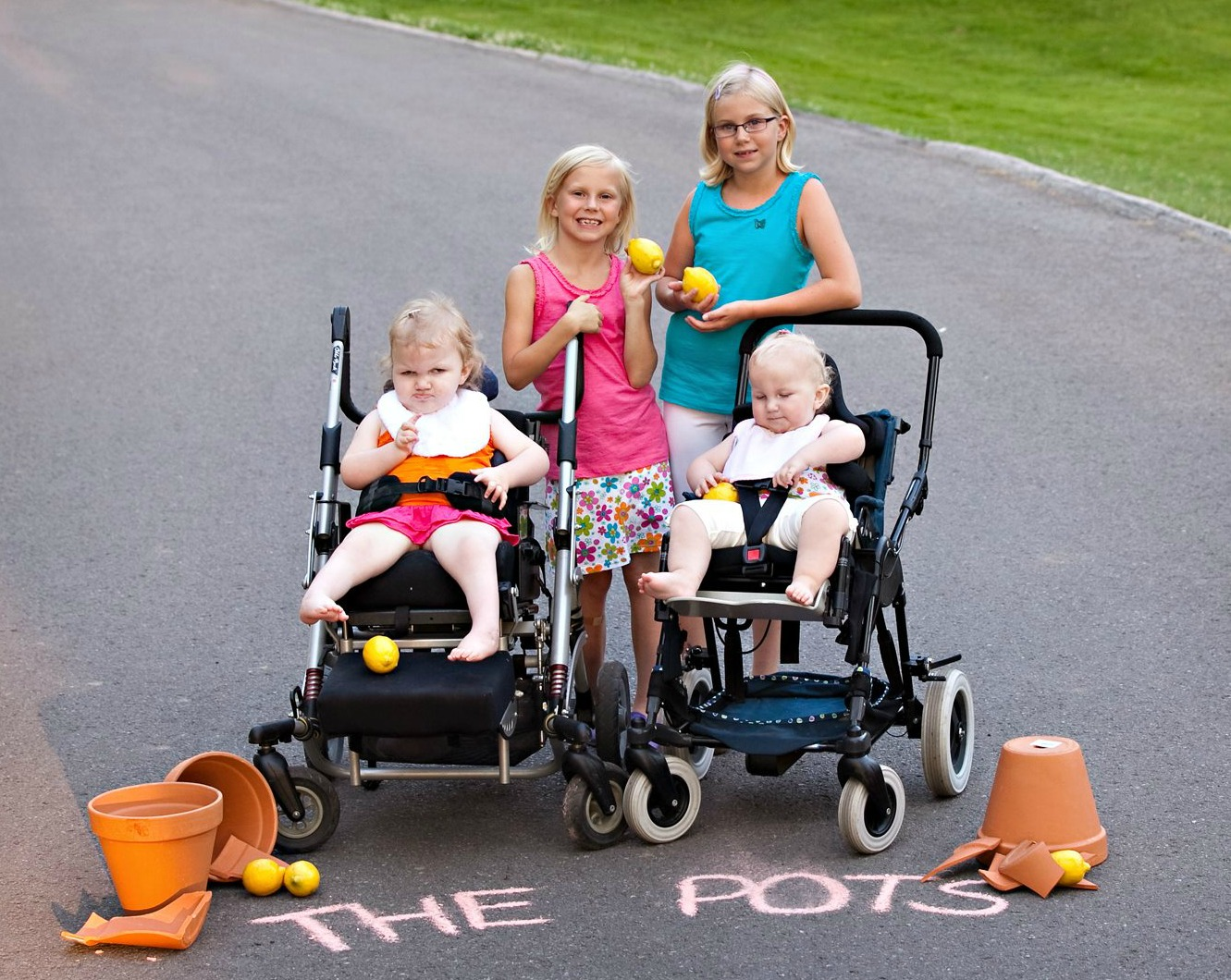
Then I heard from the Pots family in St. Catharines, outside Toronto. Pictured above are Emily, Sophia, Rachel and Janneke. Rachel and Janneke both use wheelchairs now and have global developmental delay with no diagnosis.

Their mom Sara sent me a photo (below) of an American Girl doll that Emily and Sophie had adapted to reflect their family's experience. They purchased the wheelchair from American Girl. But "the hand splint, g-tube, tinted glasses (for vision clarity) and ankle-foot orthoses were modified by 'Pot Home Health Supplies,'" Sara says, aka Emily and Sophia. "My kids get more satisfaction out of making the pieces.


"From the very beginning Emily and Sophia insisted we save money for Rachel and Janneke to have a doll in a wheelchair," Sara says. "As they began to visit the American Girl stores and website, they were frustrated to see there were little to no props for girls with disability. What I love about that frustration is that it comes from their own hearts. My hope is that they will continue to see places and things that need representation of all, not just in the doll world, but beyond."

Do your kids adapt their dolls in this way? Please send your pics to lkinross@hollandbloorview.ca and we'll share them. 

Photo by Elma Regnerus

Finding your voice

Anna Rendell presented a workshop called Me to We on the power of parents finding their voice on social media at the Ontario Association of Children’s Rehabilitative Services conference last month. She presented with parents Anchel Krishna and Darren Connolly. Below she shares how she benefited from using social media when her twins Drew and Dean, 6, were diagnosed with cerebral palsy. Anna and family are pictured above at Great Wolf Lodge.

By Anna Rendell

To get anywhere, we need to know who we are. We need a level of honesty and openness to discuss our emotions. We also need to be aware of our comfort levels, of what we want to share and what we want to keep private. When raising children with disabilities, we need to figure out our story. Social media can be a great place to do this.

When my boys were young, I was obsessed with seeking out families like mine. I hoped that connecting online with other parents would enable me to become comfortable with my “new norm,” with the normal that nobody wants and no one tells you about.

I wanted to know how people coped with their child’s diagnosis of cerebral palsy; how many parents had twins with CP, like me; how they supported their typical children; and what the future looked like for my kids.

My boys don’t have the same issues as some other children with CP, so I also wanted to connect with parents who could relate to having children who are non-verbal and have developmental disability. I think I wanted to protect what I cherished in my boys, what was normal to me, but wasn’t normal to everyone around me.

After a while I found myself overwhelmed with the Facebook groups and Twitter feeds I followed. A lot of the content was negative, and I have always lived my life positively. So I learned how to delete the feeds that were less than positive, and choose only groups that were well organized, respectful, and like-minded.

I had so much to say that I started to write a blog. I needed a place to vent, to think, to process what I was going through. I wanted to voice moments with my boys, both positive and negative. I didn’t care whether I had a large readership.

Over time, I began to see that this little blog could make small changes in how my friends and acquaintances thought. I saw that my words had power and my perspective could influence the way others looked at things. Telling my story was no longer just about me. My story could generate broader understanding in the community.

Here’s an example.

When my boys started junior kindergarten they took a cab because they weren’t walking.

I made it our annual goal to have them ready to climb on and off the bus for senior kindergarten, so that they could ride with their older sister. We incorporated physio, occupational and speech therapy into this goal and they achieved it. But it takes them longer than usual to get on the bus.

We live on a main street, which means that dozens and dozens of cars wait behind the bus while my boys get on every morning.

I posted on my blog about how every day I wave to the cars lined up, hoping that someone will interpret the gesture as a sign of gratitude for their patience. I said I wish I had a sign that I could hold that said: “If you only knew how hard we have worked for this, you would smile.”

My goal was to lighten people’s moods if they were feeling angry or frustrated about the delay.

After running this piece, I received kind messages from a handful of friends and acquaintances. They let me know they were talking about my post and now they understood why it took my family longer to get on the bus.

Recently, a friend wrote to say she was in a rush one day and started to get frustrated sitting behind the bus. Then she saw me wave and realized who we were. She remembered my piece. She cried all the way to work, knowing how hard my family worked to achieve this goal and that each step up was a great accomplishment for us.

In the early days, sharing our stories on social media helps us as parents understand who we are, and what kind of support we need. But soon, we move from that place of “me” to one of “we.” We begin to foster understanding in our friends and families and in the larger community.

Follow Anna @annakrendell and at Sometimes you have to dance in the rain. I love her recent post titled Spinning bawl of grief.

After the fall


By Louise Kinross

Today is International Day of Persons with Disabilities.

We're marking the occasion with an interview with Pia Pearce, mom to Kevin Pearce (above), an American snowboarder who was expected to win gold at the 2010 Vancouver Olympics.

Then a crash head-first into ice almost killed him.

The Crash Reel is a raw, exuberant film that follows Kevin's wild success, devastating accident, and hospitalization for a life-changing brain injury. The film takes us into the world of Kevin’s close-knit family, which includes four brothers, one of whom has Down syndrome, and the gruelling rehab that follows.

BLOOM: What is it like to have two children with disabilities?

Pia Pearce: What’s even more interesting is that in addition to David having Down syndrome and Kevin having a brain injury, my husband Simon and sons Andrew and Adam have dyslexia, so my whole adult life has been about special education. I have a doctorate in education. So it’s interesting how life turns out and we all get what we need.

BLOOM: How did having children with disabilities influence the way you responded to Kevin’s injury?

Pia Pearce: I think it was incredibly helpful to me. I had learned, over the course of time, a lot about patience and acceptance and a lot about understanding differences.

Even though David, who has Down syndrome, didn’t have major health challenges, we started early intervention with him when he was only three months old. I feel I was very fortunate in many ways with my background in education and experience with the medical field.

I had learned that you can take things that can be challenging and difficult and see a silver lining and a positive side to them. For example, my husband, who didn’t do well at school, was a huge success at home and his family celebrated all the things he was good at.

BLOOM: What kind of prognosis was Kevin given early on?

Pia Pearce: We were never given definitive information because all brain injuries are different and everyone’s rate of recovery and ability for recovery is vastly different. When we were at the rehab hospital there was a floor for patients with spinal-cord injury and a floor for those with brain injury. It was surprising to learn that everyone with a spinal-cord injury seemed to have a very similar recovery process but with brain injury there was a huge variation.

BLOOM: How long was Kevin in hospital?

Pia Pearce: He was in intensive-care for 28 days and a step-down unit for six days at the University of Utah and then he was in the Craig Rehabilitation Hospital in Denver for three months.

BLOOM: How did Kevin end up in Denver when you live in Vermont?

Pia Pearce: When Kevin was in intensive care, a good friend of ours said he’d help by doing research on rehab hospitals. He spent a lot of time on the Internet and making phone calls to other parents whose children had been in rehab. He determined that Craig Hospital would be best and then my husband and son Adam and our friend went to visit Craig Hospital and made the decision.

BLOOM: How were you able to pack up and move to Denver?

Pia Pearce: I was very lucky. It’s amazing how things fall into place and friends step up when you need them. One of my closest friends from my first year in college lives in Denver and she had a friend who had a house available. The house was on the market and they said that until it was sold, they were more than happy for us to stay there. It wasn’t far from Craig Hospital. So Simon and I moved there and our son Adam decided to take a year off from his job to be with Kevin every day in therapy.

BLOOM: The bond between Adam and Kevin really came out in the film.

Pia Pearce: They were very, very close before the accident and Adam knew exactly what would motivate Kevin. Because of the lack of insight that comes with brain injury, when Kevin came out of intensive care he thought he was way better. He wanted to go home. Adam was with him all day, every day, in therapy and was able to bring humour to the situation and make it bearable.

BLOOM: As a parent, what was most challenging?

Pia Pearce: We’re coming up on five years and Kevin is still working on his recovery. Kevin has always been very particular about the therapists he worked with. He either really liked them or he didn’t. One of the hardest parts was finding the right therapist that was best matched for Kevin.

Kevin’s had a terrible time with double vision and trying to find people to help him with his vision has been a major struggle. He’s hugely excited right now because he’s finally working with a doctor in Atlanta, Georgia who specializes in brain injury and has helped enormously.

I feel really fortunate that Kevin has been so motivated about his recovery. He was born a very determined little boy. He came out into the world with perseverance, determination and wanting to work hard and that’s why he got so good at his sport. He then took those gifts and talents and applied them to his rehab. I think the hardest thing for parents would be having a child who doesn’t feel motivated and who gets discouraged easily—and the amount of extra support that child would need.

BLOOM: What helped you keep a positive mindset?

Pia Pearce: I can’t say enough about family support and the hospitals we were in valuing that part of the process and including our whole family. I didn’t have any experiences of places where we as a family were pushed aside and that would have been incredibly difficult.

I was able to support Kevin because I was getting support from my family.

I think family support, in all different ways, is critical. I learned early on that it was better if fewer people were with Kevin, because he got easily overwhelmed. I come from a big family and I had to ask them not to come and tell them they were supporting me by not coming. Some of our family was front and centre, taking shifts with Kevin and rotating. To other people I said ‘This is a marathon, not a sprint, and we’ll need you later.’

BLOOM: Families here say they often receive tremendous support initially but then people go back to their own lives.

Pia Pearce: It’s hard for others to sustain that kind of support when it’s not something like a broken leg that gets better in six weeks. For other people, your situation falls off their radar. The same is true for the friends of the young person. Kevin was very fortunate to have very good friends. But I’ve talked to other parents who were desperately unhappy that the friends of their son or daughter were leading their child astray, minimizing their injury and saying things like ‘You’re okay. You can come for a drink.’

BLOOM: Some parents say they have to mourn the loss of the child they once had to accept their child after brain injury.

Pia Pearce: I have to be totally honest and say that wasn’t a big issue for me. I didn’t see any value in going there. Or maybe it’s what we talked about earlier—that because I’ve had so much experience with accepting differences, my focus is on acceptance. We’ve worked forever with our son David, who has Down syndrome, on accepting who he is.

I’m a firm believer in the importance of feeling your feelings and feeling the grief. I’m not about denial.

However, there was a lot about Kevin’s extreme snowboarding that was nerve-wracking for me. So I thought at least I don’t have to go to those events and stand at the bottom of those mountains freezing cold and full of anxiety. What he was doing snowboarding was very hard for me.

The other big thing was that even though he had setbacks, overall he kept getting better.

BLOOM: Some people with brain injury have a change in their personality. Was this the case with Kevin?

Pia Pearce: Some of Kevin’s friends would say he’s quite different now. But I just experience who he is now and in some ways he’s more open and communicative than he was before and more aware of how blessed he is and how important it is to live in the moment.

I understand the sense that the person isn’t exactly the same, and some people with brain injury change more than others. It’s good to acknowledge one’s feelings about who the child was in the past, but getting stuck on them isn’t very helpful.

My present moment is so full and busy I don’t see the value in choosing to spend a lot of time grieving what was or could have been. I was amazed that Kevin did as well in snowboarding as he did. Maybe if I had been the parent who wanted more than anything for my son to win a gold medal in the Olympics, I would have felt differently. But that wasn’t the important thing for me.

BLOOM: What would you recommend for parents who may be stuck in grief?

Pia Pearce: Support groups for caregivers are very helpful. I’m also a big fan of talk therapy.

BLOOM: In the film one of Kevin’s friends talks about how their roles shifted. Kevin used to be like his big brother and mentor, and now their roles are reversed. Have roles in your family changed?

Pia Pearce: I’m the mom and I’m still the mom and I’ll always be the mom! My role hasn’t changed. Adam’s role changed the most. Adam and Kevin were in the world of competitive snowboarding together and travelled together. They went from being brothers and best friends to one being so injured and the other being part of the caretaking team.

I think it’s important for family and siblings and friends to adjust their expectations of the person with brain injury, based on the ramifications of the injuries. I remember a therapist said it was hardest for parents when they didn’t get enough information from doctors so that they could adjust their expectations realistically.

BLOOM: What kind of brain injury did Kevin have?

Pia Pearce: He had an injury deep in the centre of his brain. He had to relearn everything—to swallow, walk and talk. It was like starting over with a baby, but on this warp speed. The major issues were memory, his balance and vision. He still has a lot of problems with double vision.

BLOOM: Kevin’s brother David, who has Down syndrome, plays a central role in the film.

Pia Pearce: A number of people say that David is the secret star.

BLOOM: I agree! How important was David’s plea that Kevin not return to competitive snowboarding because he didn’t want him to die?

Pia Pearce: Kevin and the other boys are very independent-minded and I realized that if I put on too much pressure it wouldn’t be helpful. But David could speak from his heart and Kevin could really hear him.

BLOOM: In one of the most moving parts of the film, David talks about hating Down syndrome.

Pia Pearce: David has a therapist and we’ve worked on that in therapy. We’ve always told David we want him to love who he is. Kevin, Adam and David have taken the film to the National Down Syndrome convention and other self-advocacy events and focused on the theme of acceptance. It’s had a very positive impact and David now is able to say that he does accept his Down syndrome.

It has been hard for him to make close friends—not so much in the elementary grades, but as he got older. More recently he has a close friend who he’s calling his girlfriend and that’s making a big difference in his life.

BLOOM: Does David work in your husband’s business?

Pia Pearce: He has three part-time paid jobs. He works in our glass-blowing business, and at a payroll agency and at our local fitness centre. He loves to work out at the fitness centre and they employ him in the operations department folding towels and filling soap dispensers.

BLOOM: What did Kevin find to replace the joy he got out of snowboarding?

Pia Pearce: He does still snowboard, but he does it for pleasure. He goes where it’s safer, where they have deep powder. He’s more aware of what a huge risk it is.

The biggest thing for Kevin and Adam right now is the foundation they started called Love Your Brain. They want to improve the quality of life of people living with brain injury. Their big push is offering free yoga classes to people with brain injury and their support workers. They’ve got pilot programs in Vermont and New Hampshire. Kevin has benefited so much from yoga and mindfulness meditation.

Kevin and Adam were just speaking to 900 managers at a Lululemon conference in Vancouver about partnering with them to promote yoga.

BLOOM: The film covers Kevin before and after the injury. Did you begin work on it before his accident?


Pia Pearce: No. We had a lot of family footage we’d taken and when Kevin began rehab, Adam and my husband Simon were great at having a camera around all the time. The doctor said that Kevin wouldn’t be able to see how he’s getting better, so it would be important to show him through video. We were able to give that footage to the director, Lucy Walker.

BLOOM: Has participating in the documentary helped or harmed the healing process for your family?

Pia Pearce: The process has been hugely helpful to Kevin and David. I can see how much it’s also helping other families who watch the film. That’s been a fantastic feeling for me: to take something that’s been so incredibly challenging and difficult and stressful and have amazing, positive things come out of it. One of the things I was happy about was that when we watched the rough cut I felt it was really honest. I felt it was an honest, accurate portrayal of who we are and how we dealt with it.


Why is it so hard?


By Louise Kinross

"Let me get this straight," my chiropractor said.

"You've had this pain in your neck and shoulders for 28 years, but you've only got $250 to fix it with?"

"Yes?" I said, with a plaintive expression on my face.

I sat on an examining table with my legs dangling in the air, like a child, and the doctor sat in front of me. I'd seen him for a series of sessions a year ago when my knees got really bad. Now my neck and shoulders, which I've had ongoing problems with, were burning. 

The night before I had to lay down on my back at 7 p.m. 

"It hurts too much to carry my head around," I explained to my husband, who was sitting in the other room. 

Shortly after that I called out: "I can't pick up my cell phone." 

"Why?" 

"It's too painful. I'm lying here with nothing to do. But it hurts too much to hold up the phone."

"Do you know how pathetic that sounds?" he said.

The chiropractor had taken a video of me to show that when I thought I was sitting with my shoulders down and even, they were completely wonky: one was way up and the other way down. When he felt my spine he said it wasn't "where it should be" and he wanted me to have an x-ray.

Why had I let things go so far? 

Just the week before when I saw my therapist I told her I was burnt out, even though I was taking a vacation day. "That's what you said the last time I saw you," she said. 

I was into the fifth week of a very exciting research project at work: nurses from across our three inpatient units were coming together for 90 minutes a week to write and draw about their emotional reactions to working in children's rehab. I was running the groups with two amazing researchers from the University of Toronto: one the illustrator in residence of the medical school, and the other heading up a new series of humanities courses at U of T, who was also  a Phd in English.

But it was something extra, on top of my regular work.

Sometimes I'd do a fantastic interview for BLOOM at work and I'd get so excited about it that I sat up late at night to finish it at home. I was also doing some personal writing at home, so after a long day of writing I'd come home with the intention of "writing" some more. 

"No wonder your shoulders are hurting, hunched over like that," my husband said as I sat at the dining room table tapping at a laptop in a distinctly unergonomic fashion.

In the morning there was the ritual of putting my son's brace on his leg and pulling him up to sit on the couch at a 90 degree angle. If I didn't take the time to lift properly, I wrenched my lower back. My husband had done this one too many times and refused to do it again, so we were no longer alternating.

"You can't keep adding more and more things to your plate," the therapist said. "You're already working full out at work and with the extra demands of your family. How about for the next three weeks you don't do any writing at night? Instead, you recover. You take a nap, or you read, or go out or do something that is completely relaxing. You take care of yourself and let yourself recover."

"Three weeks?" I said, already in a panic. "I don't think I can do it for three weeks. No, that won't happen. I'm 50 years old. Time is running out. Perhaps I can tell myself that I will pick certain days when I go home and I don't do anything at night. That sounds more realistic to me."

The therapist looked at me with a sad, knowing smile.

That night I got the stomach flu, and the next day I lay in bed, unable to go to work or do anything. It took me all weekend to recover.

A few days later I was sitting at the chiropractor's, telling him my sob story about my shoulders and neck. And it was sinking in that perhaps there wasn't a quick fix to running myself into the ground like this.

Two years ago I had a similar experience of being 'forced' into slowing down when I broke my arm badly

I know the research showing that parents of kids with disabilities have higher rates of physical and mental health problems. 

When my neck and shoulders seize up, I start to project pain into the future. If it hurts this much at 50, how much worse might it get? That freaks me out, because I have to be there to care for my son. I can't afford to be out of commission.

So here I am, 20 years after my son was born, recognizing that I still haven't learned this lesson properly. You know, the one where they say if you don't take care of yourself, you can't take care of anyone else?

And I need to.

'I do feel sad sometimes, but Kate isn't'


Last week I shared a new comment written on our most popular post The Invisible Mom by Sue Robins. The Invisible Mom is about how mothers of kids with disabilities can face the same social exclusion their kids face. Julie Drurie, mom to Kate, 7, who has a rare mitochondrial disease and took the selfie above, wrote a thoughtful response on her blog Searching For Solid Footing. We've reprinted it below. She made me think about how my perception of my child's exclusion may differ from my child's perception. Interested to hear your thoughts. Louise

'I do feel sad sometimes, but Kate isn't'
By Julie Drury

The first time I read The Invisible Mom I didn’t think that was me. I understood it and felt strong empathy for Aaron’s mom, but I didn’t think I felt the same pain and angst of exclusion as she.

But then I started considering how Kate is ‘included’ and ‘excluded,’ deliberately or not. I reflected on the moments where her differences stand out so starkly and where I hustle to make excuses for her…

…“she can’t hear you.”

“yes, she’s 7…but she’s more like a 3-4-5 year old.”

“she is signing or saying this that or the other thing.”

“well, she could come to the party…but maybe I should come too…to help…and she’ll probably have to leave early.”

She’s the kid who leaves early from school, is often sick, wears the funny helmet, has a tube in her nose, doesn’t speak, sometimes hits the other kids, is often in her wheelchair stroller because of fatigue, runs away and won’t come back, doesn’t understand when you ask what her favourite colour is (but she can tell you her name and how old she is!!). Some (few) make an effort to include Kate, but playdates, birthday-party invites and get-togethers with the girls are not really part of her life, sadly.

She loses her peer group annually as others grow and mature and learn and she is left behind. Her reality is that adults are her friendsand the few children whose parents facilitate them staying engaged with Kate.

Do I feel left out? Sometimes, yes.

Am I sad? Yes, I grieve ‘loss.’

More importantly, does Kate feel left out? No. Is she sad? Nope. She has her friends at school that will change year to year, but that she values nonetheless. She has her friends at Rogers House (Myah, Moon Pie, Buffa, Mat-teww), and her adult friends (Christine, Kat, Erin, Kara, Adrienne, Vanessa, Steffi, Tall Steve, and more) that she loves. She is developing her own friendships and through those connections, I am finding my peer group of moms and friends as well. A different peer group than what you would expect, but a very valuable one.

I don’t think I am an invisible mom. I think people see me. If they don’t, I usually make them see me and Kate.

I wish for so many things for her. I wish for playdates and friends and movies and outings and independence.

I do feel sad sometimes. But Kate isn’t. Not yet. For now she is happy. Like Aaron’s mom I hope she never has to understand or become aware of the pain of invisibility.


Tell us your story

What do you want people to know about being a special-needs parent? 

What do you wish people understood about parenting a child with a disability or chronic health condition? 

Tell us in the comments! Louise

'Mom, why are people staring at us?'

By Christina Herbers

It was a chilly Saturday morning as I drank coffee and thought about a family activity that would be fun for both of our girls. I decided that we’d spend the day like many other St. Albert families, so we headed out on an adventure to Servus Place Rec Centre.

My husband and I were excited, as it was the first time our youngest daughter Addison was trying out her new hockey skates. We packed up all of the skates, snow pants, mitts and toques, piled the girls and all of their stuff into our mini-van, and headed out. We entered Servus Place.

And then it started.

I had tried to prepare myself on the van ride over: People will stare, I told myself. Don’t let it bother you. Just enjoy your Saturday. But, despite best efforts, it always gets to me.

“Mom, why are people staring at us?” asked Addison, 3, voicing the words in my head.

I’ve asked this question for seven years, ever since my daughter Jaina was born with multiple disabilities. But I wasn’t sure I knew the answer. Why was this simple question so difficult for me to answer?

Should I tell my younger daughter the truth? And, if so, what is the truth, or what version of it is she ready for? I want to protect her innocence.

I wish I could open it up to the strangers who stare. I know we are different, but because you stare silently, you magnify the differences.

I wish I could ask people: Why do you stare? Do we make you uncomfortable? Do you have questions? Do you feel sorry for us? Do you pity us? Do you love Jaina’s pink wheelchair? Maybe you have not yet seen a beautiful angel like our dear daughter Jaina. Maybe she is the first angel child that has crossed your path. You see, Jaina very nearly died before she was born.

In January 2006, my husband placed his hands on my belly and felt Jaina kick for the first time. I thought to myself, we’re halfway there!—halfway to fulfilling my dream of having a family. I was 20 weeks pregnant, and my baby would be born in another 20 weeks, sometime at the end of May.

Then the car accident happened. We were driving home from a dinner with friends. In an instant, the baby I had dreamed of suffered a major injury. My spleen burst upon impact, and my baby went without air for a few minutes. In those minutes her life changed forever. A key part of Jaina’s brain stem calcified, so she would never be able to walk, talk or breathe or eat on her own.

I’ve come to believe that our beautiful Jaina was specially placed in our family for a reason.

The reason wasn't clear to me initially. I went through all the stages of grieving the child that I thought I would have. When Jaina was in Stollery Children’s Hospital for the first months of her life, I was in serious denial. Then, for many years, I was angry. And now, I can finally accept.

I believe Jaina is here to guide us to a future where we all belong: a future where families like ours are not stared at, where we are welcomed with smiles.

Let’s open up the dialogue between us. Ask the hard questions. Bring your children and come over to say hi to our family. Ask me how we are doing. Ask about the weather. Ask me about Jaina. Just talk to me. Include us in your community.

Together, let’s abandon our outdated beliefs about what defines the “typical family.” Let’s work towards a future of acceptance and inclusion. Let’s create a supportive community, one made up of people and families of all types.

Some of us may look different, and some of us may speak different. And some may be angels walking among us. That is my Jaina. She is here to bring peace. She is a calm, peaceful force. She does not suffer, and she is not in pain. She has fought to be here since before she was born. She does not know any different. To her, she is perfect, just the way she is. She has touched many lives, and I hope that in some small way, she can touch yours.

Christina Herbers is mom to girls aged five and eight. She works part-time as a consulting engineer, and is a writer, volunteer and weekend warrior living with her husband and children in St. Albert, Alberta.


Sadie at the salon

By Emily Urquhart 

My three-year-old daughter, Sadie, was getting her hair cut at a new salon. This would be enough to set any parent on edge—the possibility of tantrums, a stranger wielding a sharp object near your child’s face—but I was most worried about the inevitable comments.


My daughter has albinism, which means she has white-blonde hair, little pigment in her skin and has pale blue eyes. She has low vision, so facial expressions and the identity of people standing at distances more than 10 feet can be difficult to decipher.

At our regular hair salon, which is bubble-gum pink and caters to the pre-tween set, I’ve put a note in Sadie’s file so that the stylists won’t make inappropriate comments or ask questions about her hair. A few times employees have missed the memo but mostly they stay mum, Sadie watches part of Frozen, and she walks out with a lovely little page-boy cut.

Today, however, we were in the middle of an extended visit with my parents in their small town and Sadie’s hair needed a trim, so I reluctantly brought her to a tiny salon on the main street. Deb, the owner, styled my grandmother’s hair until she died in 2007, and she’s cut both my hair and my mom’s hair. Four generations down, she was clearly perplexed by my daughter’s icy locks.

“It looks like there isn’t any colour at all,” she said and then asked if Sadie’s hair had been bleached by the summer sun. My mother was with us, and she stepped in to explain albinism. I felt my chest tighten. My little girl sat silently in the adult-sized chair, propped up on a phone book and engulfed in a silvery hairdresser’s cape.

Then, the doorbells chimed and a soft-bellied farmer stepped into the shop.

“No time today, Al,” Deb said. “I’m booked.”

Al sighed, tugged at his suspenders and lingered in the doorway for a moment.

“That’s some white hair,” he said nodding towards my daughter. “I’ve only seen that kind of hair once before. The Millers over in Belford. The whole family had white hair like that.”

He was referring to a nearby town (I’ve changed the surname and the location). I don’t know this family but it’s quite possible their hair is the result of the same genetic condition that affects my daughter. Albinism is rare
occurring in 1 in 20,000 to 40,000 depending on the type—but it could be connected. 

It was an interesting thought, but mostly I wondered, Couldn’t this just be a haircut? Why do so many of our interactions need to be a science lesson? Most importantly, How was my daughter interpreting this interaction about her appearance?

When Sadie was younger strangers’ comments sometimes wounded me but I didn’t need to worry about how they affected the tiny white-haired infant asleep in my arms. People asked me if I dyed my baby’s hair (um, no), or if her hair was white (yes), or if her father had very light hair (nope). Occasionally I took the opportunity to educate the inquirer on recessive genetics but mostly I politely answered the bare minimum and went on with my day.

Now, the comments and questions are often pointed in my daughter’s direction. It is not her role, at three, to educate the overly curious masses. Mostly these are compliments on her hair, and on the little pink-framed eyeglasses she wears to correct what she can of her vision. I encourage her to say thank you because it’s polite, but sometimes I wonder if doing so feeds into an idea of otherness that I don’t want her to grow up with. These people, however kind and well-intentioned their comments might be, are singling her out as different—over and over.

It is not an exaggeration to say that Sadie and I field questions and address observations every day. Aware that my daughter is listening, I respond with confidence and warmth, but I’ve also walked away or ignored people—especially when they speak loudly about my daughter but not to her or to me.

As a parent I am still navigating uncharted territory. What I know for certain is that how I respond sets the tone for how Sadie feels about these encounters. I can’t stop them from happening but I can mitigate their impact on my daughter. At least for as long as she’s by my side, and when she’s not, she can follow my example.

For my part, I can learn from other parents of kids with albinism as well as people who share my daughter’s genetic condition. Since Sadie was one-and-a-half we’ve attended two National Organization of Albinism and Hypopigmentation conferences. It was a relief to connect with other families like us and to vent about some of our common frustrations. Everyone there had faced remarks about their or their child’s appearance. There was an entire session on how to navigate these tricky social experiences.

This presentation made me feel less alone and offered some excellent tips, like having a short, rehearsed story at the ready for difficult occasions. But it was another mom who shared the most surprising piece of information. She said her eight-year-old daughter loves having albinism because of the compliments she gets on her hair and glasses. The barrage of unsolicited comments has actually worked to boost her confidence. I had never considered this possibility.

Leave it to an unjaded child to rearrange how you see the world. What I’d seen as intrusions, this little girl viewed as self-affirmations. She taught me that how you receive comments are as important as how you react to them. If you perceive these words as arrows they will wound you and leave visible scars. If you receive them as gifts, they have the ability to enrich your life.

Not that every interaction involves a compliment. Like the farmer in the hair salon, many people simply state their observations. But I have a way of turning these situations around.

“Her hair is really white,” the cashier/mom-at-the-park/stranger-on-the-street/fill-in-the-blank will say.

“I know,” I’ll respond, remembering the little girl from the conference. “Isn’t it beautiful?”

Emily Urquhart is a folklorist and writer. Her book about genetics, parenting and storytelling, Beyond the Pale: Folklore, Family and the Mystery of our Hidden Genes, will be available in March 2015 from HarperCollins. 

Star-studded 'Serenade' benefits Beverley School families

By Julie M. Green

What does indie music have to do with children with special needs? 

Toronto singer/songwriter Hayden Desser and his wife Christie Greyerbiehl worked tirelessly to marry the two for one extraordinary night last Saturday. 

The result was Dream Serenadea concert at Massey Hall to benefit children with developmental and physical disabilities at Beverley School in Toronto. The evening was spectacular, with performances from Feist, The National, Sarah Harmer and Billy Talent, to name a few.

Like many of us, disability wasn't on Hayden's radar until someone he lovedhis daughterwas affected. And while much has been done to raise awareness of disorders like autism, there's a glaring lack of funding for therapies and family support.

Three years ago my son was diagnosed with autism at Holland Bloorview. Aside from a block of publicly-funded speech therapy, any support he's received has been paid for privately, by us. Friends and family are staggered when they learn that this is our reality. I know of too many couples forced to re-mortgage their homes or cash in life savings (assuming they're lucky enough to have savings) in order to afford programs for their children.

With my husband’s family overseas, and my own family living several hours' away, respite is virtually non-existent. And our son's needs are such that we can't get the neighbourhood babysitter to look after him while we take a much-needed break.

Demand for public services outstrips supply. Many children simply aren't getting the help they need, when they need it. Some are rejected for programs they should qualify for, while others sit on wait lists for years, missing out on early interventions so vital to their development.

When searching for childcare for his daughter, Hayden discovered firsthand how hard it was to find an appropriate program. Today, his daughter is a student at Beverley.

Hayden created the annual Dream Serenade to support this cause close to his family's heart.

Proceeds from the inaugural event will fund assistive technology and a custom green playground at Beverley School and also provide respite services to families.

When artists lend their voices to meaningful causes, the result is a thing of beauty. On Saturday night, the atmosphere at Massey Hall was electric. 

But oddly, the highlight of the evening wasn't the Barenaked Ladies goofing around on stage. It wasn't the haunting tones of Matt and Aaron from The National, or the audience singing along to Feist's hit "1, 2, 3, 4." It wasn't even Hayden's moving tribute to his daughter in a new song.

No, the highlight was video footage of the lit-up faces of the Beverley kids during an impromptu jamming session with the performers the day before. 

See you at next year’s Dream Serenade!

Julie M. Green runs a special-needs blog at Yummy Mummy Club. Check out the photo of her below with her son. Photo of the concert above by Farida Peters.